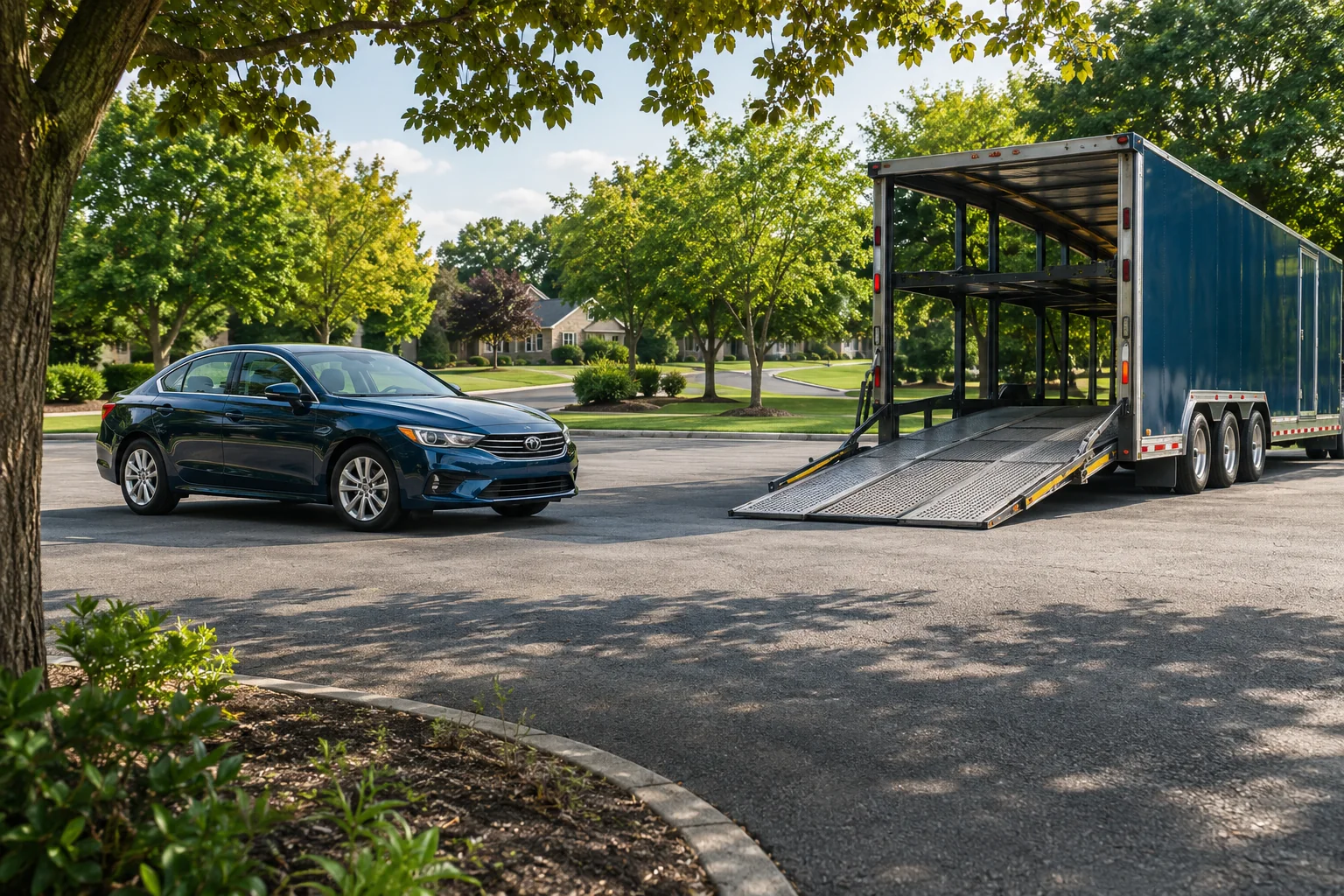
What door-to-door service needs to mean
Door-to-door car transport describes a service arrangement in which pickup and delivery are coordinated near the locations you specify. The useful question is how close the assigned equipment can legally and safely get to each address. A residential driveway, apartment entrance, dealership lot, and rural lane present very different conditions. Treat the words in an advertisement as an invitation to define the actual handoff, rather than a promise that a truck will stop beside any front door.
Before booking, ask the provider to explain what happens when either address is inaccessible. Find out who chooses a replacement location, how much notice you should expect, and whether a change could affect the price. An accessible meeting point might be a short drive away, but that distance still matters if you have already shipped your only vehicle or cannot leave a child unattended. Put the address and the fallback arrangement in the written shipment instructions.
The service also depends on the transport method. A large multi-vehicle carrier needs different maneuvering space from a smaller trailer. An enclosed trailer may have different unloading clearance from the equipment pictured on a website. Read how auto transport works before deciding which details belong in your booking. Ask for the equipment actually planned for your shipment as soon as it is known, and revisit the access plan if that equipment changes.
Assess the entire approach to your property
Start outside your own street. A truck must reach the neighborhood before it can approach the home. Consider narrow turns, traffic islands, steep entrances, low branches, overhead structures, gated roads, parked cars, and places where a long combination cannot turn around. A clear driveway does little good when the only approach involves a restricted bridge or a corner blocked by landscaping. Describe visible obstacles honestly and let the carrier evaluate the route with the vehicle dimensions in mind.
Photographs can improve that conversation. Take wide views showing the road approaching from both directions, the entrance, the curb, and any gate or slope. Include a view that shows where the truck would exit. A close photograph of the driveway surface cannot show the room available for a turn. Do not stand in traffic to take pictures, and do not try to measure overhead wires yourself. Report what you can safely observe and ask the professional responsible for the truck to make the operating decision.
Online maps help locate an address, but a pin does not establish permission or current access. Street images may predate a construction project, a newly posted restriction, or a tree that now overhangs the road. Ask the property manager or local road authority about a specific concern when necessary. For example, the management office can clarify whether commercial loading is allowed at an apartment complex; the transport provider should then confirm whether the available area suits its equipment.
Separate permission from physical room
A location can look spacious and still be unsuitable. A private parking lot belongs to someone, and its owner may prohibit vehicle transfers or commercial trucks. A public curb can carry loading restrictions even when no cars are parked there. A wide road may have no lawful standing area. Do not tell a driver that a shopping center, school, or business has approved a meeting unless you have actually obtained permission from an authorized person.
Ask practical permission questions early. Which entrance can the carrier use? Are deliveries restricted to particular hours? Does the property require advance notice, a gate code, a security escort, or proof of a service appointment? Will the lot remain open when the truck arrives? Record the name or office that approved access and share only the information the carrier needs. Avoid posting private gate credentials in a public review or on an unsecured community message board.
For curbside handoffs, ask the local authority or property manager who controls the road if the rules are unclear. Do not assume that hazard lights create permission to block a lane. The customer should never direct other vehicles around a loading operation or stand behind a reversing truck to help it fit. If the site does not support an orderly transfer, choosing another place is a logistics decision worth making before the driver arrives.
Choose a workable meeting-point alternative
A good alternative provides enough space for the assigned truck, a permitted place to stop, and a practical route for the owner or representative. It should also allow a careful vehicle inspection away from moving traffic. These requirements are more useful than a familiar brand name or a suggestion that any large parking lot will do. Ask the carrier to approve the exact entrance and meeting area, because different parts of the same property may have different access conditions.
Consider the return journey. At pickup, someone has to leave the meeting point after handing over the car. At delivery, someone has to reach it before taking the car home. A family member, taxi, rideshare, or second vehicle may solve that problem, but availability varies by location and hour. Include the cost and time in your planning. For a broader view of small logistics expenses, see the guide to car delivery costs.
Write the alternative clearly enough for a person unfamiliar with the area. Use the street address, a recognizable entrance, and a contact number. Avoid instructions such as 'the big lot near the highway' when several lots match that description. Confirm that the driver can contact the receiving person directly, while keeping the broker or dispatcher informed. If the first alternative closes or becomes crowded, stop and agree on another location instead of improvising across a busy road.
Coordinate apartments, gates, and shared properties
Shared properties add people to a handoff that might otherwise involve only the owner and driver. A concierge may admit residents but lack authority to admit a commercial truck. A gate may open for cars while leaving insufficient clearance for a carrier. A service road may belong to a neighboring property. Work through these details with management before naming the front entrance as the pickup point, especially when the building has separate visitor and delivery access.
Give management the expected window without promising an exact arrival that the carrier has not committed to. Ask whether an appointment can be adjusted if the route changes. If a reserved loading space has a fee or limited duration, learn when that charge begins and who pays it. A plan that depends on a ten-minute slot may be too brittle for a long-distance truck arrival. Where access is uncertain, an approved meeting point outside the property can reduce confusion for everyone.
The resident still needs to prepare the vehicle itself. Remove access cards and personal documents unless the carrier specifically needs an item and accepts responsibility for it. Keep a gate remote with you when it is needed to get home after delivery. Read the guide to personal items in a shipped car before leaving belongings in the cabin. Property access and vehicle cargo acceptance are separate decisions, even when both arise during the same conversation.
Build an address-level handoff record
Create a short instruction sheet for each end of the shipment. It should identify the vehicle, owner or authorized contact, street address, proposed meeting location, known access limits, and backup contact. Describe mobility constraints or unavailable hours that materially affect the handoff. A receiving person who works across town may need more notice than someone waiting at home. Clear information gives dispatch a realistic basis for coordination and prevents the driver from relying on assumptions about your schedule.
Keep the sheet current. If you move into a different building, change phone numbers, or appoint another representative, send a dated update through the provider's established communication channel. Ask for acknowledgment when the change is important. A revised address buried in a text conversation may not reach the driver automatically. Check the booking documents as well, because the agreed service location should match the place the provider is arranging to serve.
Protect the evidence from the handoff. Photograph the car in sufficient light, record visible condition, and keep copies of the documents you sign. Choose a meeting area that allows access around the vehicle without putting anyone in the roadway. If rain, darkness, or dirt makes inspection difficult, describe the limitation in the record and ask how the carrier handles follow-up. For document organization through each stage, use car freight documents and handoffs.
Identify the company arriving at the meeting point
A practical location does not replace provider verification. FMCSA's automobile transporter advisory explains that a broker arranges transportation while a transporter performs it. When a carrier is assigned, obtain its legal name and identifying details rather than relying solely on the booking brand. This helps you establish who is expected to take custody of the vehicle and who should answer questions about the truck's approach.
Before releasing the keys, compare the arriving company and shipment information with the assignment you received. If a different company appears, contact the known dispatcher through a number you already verified. A last-minute explanation from an unfamiliar caller should not be your only confirmation. The aim is to resolve an inconsistency while the car remains with you. Do the same when an unexpected person asks to collect the car before the carrier arrives.
If your booking involves an intermediary, keep responsibilities distinct. The broker may coordinate the meeting, while the carrier decides whether its truck can operate there. Ask who will notify you of changes and who can approve a different address. Read working with an auto transport broker for the contracting and communication questions that belong alongside the access plan. A single shared instruction record can help both businesses work from the same facts.
Prepare for a changed arrival without losing control
Traffic, earlier stops, weather, and property conditions can change the practical arrival time. Agree on a notice process rather than assuming a driver will arrive within a narrow personal appointment. Ask how the provider distinguishes an estimated time from a confirmed appointment and how updates are sent. Then arrange a backup person who understands the vehicle and has authority to complete the handoff if you become unavailable.
A backup person needs more than a phone number. Explain how to review the condition record, what documents may need a signature, where the vehicle should go after delivery, and whom to contact if something differs from the booking. Give them the payment instructions that you independently confirmed, without sharing unnecessary account details. If the car has unusual controls, provide concise manufacturer-based instructions and tell the carrier before pickup so a surprise does not arise at the meeting point.
When a location change introduces a charge or changes the service scope, request the revised terms in writing before accepting them. Keep the reason for the change with the booking record. A reasonable access adjustment should still be understandable: the new place, the additional service if any, the amount if any, and the party authorizing it. With those details settled, door-to-door service becomes a defined plan that both ends of the journey can carry out.
A final access review before pickup day
Review both addresses together, even if only the pickup street seems difficult. A smooth departure does not solve an inaccessible destination, and the receiving person may notice obstacles you cannot see remotely. Ask that person to check the entrance, parking conditions, management hours, and expected roadworks. If the car is going to a repair shop or dealership, confirm that the business has agreed to receive it during the likely arrival window and can identify the shipment correctly.
Make the vehicle available at the agreed point without leaving it unattended in an unauthorized area. Keep enough personal time available for inspection and questions. A rushed transfer can cause avoidable mistakes, such as forgetting a spare key or accepting a document with the wrong vehicle details. If a driver cannot safely stop, communicate from a safe location and work through dispatch to identify a suitable place. Do not follow a moving carrier while trying to negotiate directions by phone.
After delivery, save the final address, inspection record, and any access-related correspondence with the rest of the shipment documents. That record can help explain an additional service or clarify where custody changed. It also gives you a practical starting point for a future move, although you should recheck current permission and equipment each time. Neighborhood access changes, and a meeting point that worked for one truck is a candidate for review rather than permanent approval.
Sources and further reading
Dates and the scope of individual rules are explained in the guide. Use the linked authority or operator to confirm requirements for your shipment.