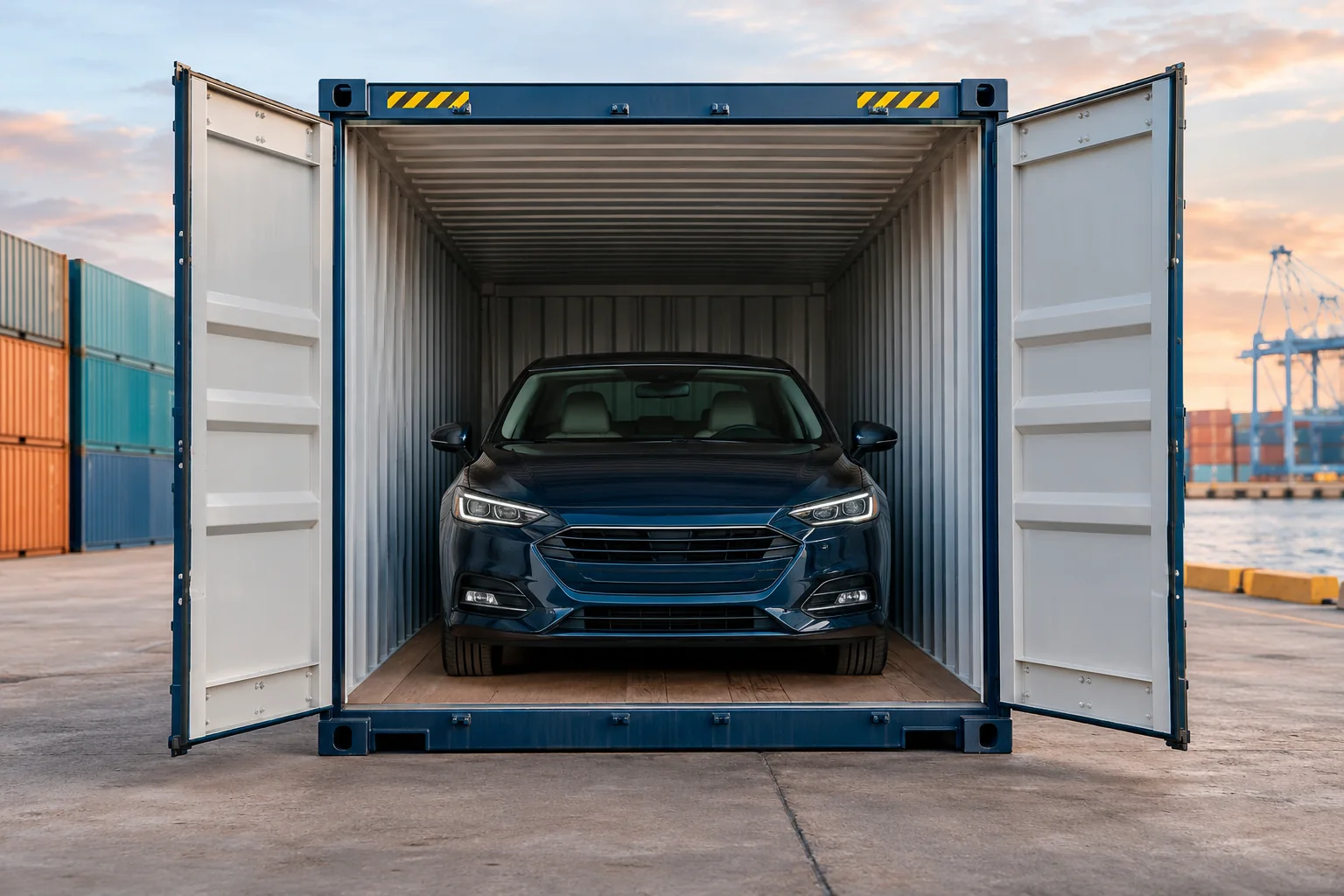
Describe the complete container service
Container car shipping places a vehicle inside a freight container for part of its journey. That description does not tell you who collects the car, where it is loaded, whether the container is shared, or who releases the vehicle at destination. Ask for the service as a sequence of named locations and responsible parties. The practical shipment may include inland transport, a loading warehouse, an origin terminal, ocean carriage, a destination terminal, and a separate unpacking facility.
Distinguish a container delivered for loading at a specified site from a vehicle delivered to a professional loading facility. Those arrangements create different access and handling requirements. A customer who can park a car in a driveway does not necessarily have space, equipment, or permission to load a shipping container there. Confirm the plan before arranging the first collection. The international shipping guide separates freight from export, import admissibility, and destination registration.
Write down the beginning and end of the service you are buying. “Port to port” may leave substantial work outside the agreement, while a broader arrangement still needs its exclusions explained. Identify who makes bookings, files information, pays local charges, and answers questions at each handoff. A container protects a defined space, but clear responsibility protects the continuity of the journey.
Confirm the vehicle fits through the actual opening
Container size names are only a starting point. The car must fit through the door opening, occupy an acceptable position inside, and leave the space needed for professional loading and securement. Use the vehicle's actual dimensions, including mirrors, roof equipment, modifications, and any parts that remain attached. Overall container length does not establish usable clearance for a particular vehicle or loading system.
Maersk lists several dry container types and sizes, illustrating why equipment type must be specified rather than assumed. Request the relevant specifications from the provider for the equipment actually proposed. Ask the loading professional to confirm door clearance, internal space, weight limits, and handling access. Avoid relying on a generic diagram when the assigned container or loading arrangement can differ.
A car that physically fits may still need a different plan if its doors cannot be opened safely after positioning or its tie down points are difficult to access. Do not solve that problem with improvised climbing or unsupported movement instructions. Explain low clearance and unusual bodywork early. The special vehicle handling guide offers questions about manufacturer instructions and loading needs that also matter inside a container.
Compare exclusive and shared space carefully
An exclusive container and a shared container can involve different scheduling and custody arrangements. Ask whether you are booking the whole container, a defined vehicle position, or a consolidated service assembled by a forwarder. If other cargo shares the space, identify who decides what is loaded and how your car is separated and secured. Do not assume “container shipping” means your vehicle travels alone.
Shared service may depend on consolidation and deconsolidation at warehouses. Establish whether the stated departure timing is tied to a particular confirmed sailing or depends on assembling a load. At destination, the vehicle may need to wait for the container to be moved to an unpacking facility and processed before collection. The ocean vessel's arrival date therefore may not be your vehicle's available collection date.
Exclusive space also needs a full plan. Determine whether the container remains sealed through the intended route, what inspections can occur, and who records seal changes. An exclusive booking does not eliminate customs inspection or guarantee immediate terminal release. Compare the total scope, preparation work, timing, and destination handling through the international cost guide. The useful choice is the arrangement that fits your car and receiving plan under clear terms.
Use professional blocking and lashing
A car inside a container must be restrained for the forces and handling encountered during the journey. Ask who performs the loading, blocking, bracing, and lashing and what professional procedure applies. Enclosure alone is not securement. The carrier and loading facility need a plan suited to the vehicle, container, route, and any other accepted cargo. This work should be completed by people equipped and authorized to do it.
Provide the vehicle's handling instructions, actual weight information where required, and any restrictions on tie down or towing points. Disclose whether it can start, roll, steer, and brake. A disabled car may require different equipment and a different unloading plan at destination. The non-running car guide helps distinguish those conditions without assuming a winch solves every movement problem.
Ask for an appropriate loading record, including photographs and an inventory when relevant. This should identify the car and show its condition and placement without requiring you to direct technical methods remotely. If a proposed setup seems unsuitable, ask the responsible professional to reassess it before departure. A customer should not improvise timber placement, attachment methods, or hazardous loading steps from an article. Your useful contribution is accurate information and a clear acceptance record.
Do not assume the container accepts household belongings
An enclosed space can look like an invitation to pack the car or surround it with furniture. Acceptance depends on the actual service, carrier, loading plan, commodity declarations, and destination rules. Ask explicitly whether personal effects are permitted, where they may be placed, how they are inventoried, and what coverage applies. A forwarder's willingness to discuss mixed cargo does not establish permission from every carrier or authority involved.
For a concrete operator example, Matson's household goods container FAQ limits the described combined private vehicle and household effects arrangement to its specified Alaska and Tacoma service. That is a route specific operator policy, not a general rule for containers worldwide. Your booking needs its own confirmed instructions. The contents guide separates acceptance, weight, insurance, and customs questions.
If mixed cargo is accepted, disclose it fully before the loading plan is finalized. Ask about prohibited or regulated items and destination inventory requirements. Do not put fuel cans, chemicals, loose batteries, or other potentially restricted objects into a closed vehicle to avoid describing them. Hiding cargo can complicate inspection, create safety concerns, and leave you without a workable release plan. Separate shipping is often simpler when the belongings require a different service.
Verify the forwarder and ocean contracting party
Identify the company arranging the shipment, the party issuing the ocean transport document, and the ocean carrier. These roles can differ. The Federal Maritime Commission explains ocean transportation intermediaries, including ocean freight forwarders and non-vessel-operating common carriers. Determine which role your provider performs rather than treating all businesses involved as one shipping company.
For the relevant United States ocean trade, use the FMC's OTI list to check the applicable entity and status. Match legal names and contact details to your agreement. Ask who handles inland carriers and who will act at destination. A company that helps with the origin booking may use a separate overseas agent whose local fees and release instructions need to be understood before arrival.
Read the transport terms and any cargo insurance proposal separately. Carrier liability and a cargo policy can have different limits, exclusions, valuation rules, and claim procedures. Ask which stages are covered, including warehouse handling and inland legs. Identify how pre-existing damage, mechanical issues, contents, and loading work are treated. A statement that the container is insured is too vague to establish what protection applies to the vehicle inside it.
Complete export and destination checks before loading
Confirm export documents while the car and original ownership records remain available. CBP's motor vehicle export guidance explains the requirements for used self propelled vehicles and the relevant presentation timing by export method. Follow the port's procedures and obtain guidance on your specific ownership situation, including liens or other restrictions. A container booking does not waive vehicle export obligations.
Determine destination admissibility before paying for an irreversible journey. A car may face requirements related to age, emissions, safety standards, steering configuration, taxes, or importer status. The destination authority and an appropriately qualified local customs professional should confirm what applies. Import permission, customs release, and registration remain separate tasks. Do not assume a vehicle exported legally from the United States will automatically qualify for road use abroad.
If personal effects or spare parts travel with the car, ask how they must be declared and inventoried. Confirm who files information, which documents you must supply, and the deadlines measured against the actual vessel booking. Keep copies of submissions and acknowledgments. The freight document guide helps organize this chain so a missing declaration does not become apparent only after the loaded container reaches the terminal.
Record the vehicle before it disappears from view
A container shipment can keep the vehicle out of sight through several stages. Create a clear condition record before the initial handoff and obtain the loading facility's record if that is a separate event. Photograph visible surfaces, glass, wheels, and any disclosed defects. Record the VIN, odometer, keys, accessories, fuel or charge state, and operating condition according to the service instructions.
Ask how the container number, seal number, and loading date will be provided. Those identifiers help connect the car to the freight movement, but a seal is not proof that no authorized inspection occurred later. Request a procedure for recording seal changes or inspection events where available. Keep warehouse receipts, inland condition reports, loading photographs, and ocean documents together so the custody sequence can be followed.
If someone else releases the vehicle, provide instructions on what they may approve and which records they must obtain. A family member may be able to hand over keys without having authority to accept a new loading arrangement or additional charge. Explain the escalation contact in advance. Accurate records do not prevent every problem, but they make it easier to identify where a discrepancy first appeared and which party needs to respond.
Plan destination unloading and local movement
Before departure, establish where the container will be unpacked and who can collect the car. Terminal release, customs release, warehouse availability, and vehicle collection can occur at different times. Ask how the destination agent will notify you that the car is actually ready, what documents identify an authorized collector, and what charges must be settled. Do not book a nonrefundable collection trip based only on the vessel's scheduled arrival.
Confirm unloading equipment and the vehicle's expected condition. If it was accepted as non-running, the destination must have a compatible plan rather than expecting you to drive it from the container. If the car is drivable but not locally registered or insured for road use, arrange lawful onward transport or storage. Delivery to a warehouse does not itself authorize a road journey from that warehouse.
Review storage, terminal time, equipment return, and other time related charges under the applicable terms. Ask when each clock begins and which party can stop it by completing a task. Keep the destination agent's contact information accessible in the local time zone. The container shipment record should remain the reference point for the agreed plan, with revised release instructions attached as the arrival date becomes clearer.
Finish with inspection and a complete file
Inspect the vehicle at the earliest practical destination handoff and compare it with the origin records. Photograph concerns, note conditions on the appropriate receipt, and follow the reporting procedure in the agreement and cargo policy. If unpacking is performed before you attend, ask what condition evidence the facility produces and how you can obtain it. Keep relevant packaging and loading materials when they may help explain a concern.
Retain customs release evidence, warehouse receipts, payment records, and the final vehicle delivery acknowledgment. Reconcile the charges against the service scope and approved changes. Record any outstanding registration or compliance work separately so possession of the vehicle is not mistaken for permission to use it on public roads. A container move is complete when the vehicle is released, received, and accounted for, with the next local steps clearly assigned.
For a future move, keep a short note of the arrangements that affected timing: warehouse receiving hours, the consolidation process, document completion, and the interval between vessel arrival and vehicle availability. Those facts are more useful than a single total transit figure. They show which stages were predictable and which required flexibility.
If you need to compare another provider later, give it the same vehicle facts and destination scope. That makes the comparison about real loading and release work rather than the container label alone.
Sources and further reading
Dates and the scope of individual rules are explained in the guide. Use the linked authority or operator to confirm requirements for your shipment.